Tuesday, December 25, 2007

Holy Land Tour Fall 2008

Israel has been one of the most important crossroads of the world for 40 centuries and numerous cultures and civilizations have left their mark on this ancient land. But more than that, Israel is the birthplace of faiths that have enveloped the world. Judaism, Christianity, and Islam find their roots in this land. Moreover for us Christians, Israel is the land where our Savior and Lord lived his earthly life.

A trip there is more that just a tour. It can make the pages of the Bible come alive for you as walk the places where Jesus walked, gaze upon the vistas He would have seen, and come into contact with the land that touched His imagination - just as it will touch yours. In addition to seeing some of the greatest historic sites in world history, you will spend time in daily devotions, worship, and communion.

We invite you to join members and friends of First Presbyterian Church of Ellensburg on a once in a lifetime tour of the Holy Land in the Fall of 2008.

Below is a day by day listing of the places we plan to tour. If you have any trouble viewing this site, it's probably because of all the pictures. Try viewing one day at a time by using the links to the right.If you are interested in joining us, please take time to read the "Additional Information" post near the bottom and feel free to contact me if you have any questions. Special thanks to my friend Todd Bolen for some of the pictures on the site. Todd has lots of great stuff at http://www.bibleplaces.com/.


Join us as we visit the crossroads of the world and walk in Jesus footsteps.

Pastor Al Sandalow at St. Catherine's Monastery in the Sinai
PS: If you'd like to download a brochure for this tour, right clip on this like and select "save target as" to download an Adobe PDF file. It's a big file and may take a while to download.

Day 1 - Seattle to Chicago to Istanbul


Friday, October 24

Most of us will start the day early, with a flight from SeaTac airport to O'Hare airport in Chicago, where we will board a Turkish Air nonstop evening flight to Istanbul. Others who are not starting the trip in Washington state will meet us at Chicago.

Day 2 - Arrive Istanbul

Saturday, October 25


After an overnight flight we land in Istanbul and start touring right away. Everyone needs a tourist visa ($20 cash). We'll pick up our luggage and be met by our Istanbul tour guide.


Today we'll visit several sites. First, we visit an amazing church that once was on the outer edge of Byzantine Constantinople, the Chora Church. Here we see beautiful frescos and mosaics that were hidden under plaster for 700 years. We'll visit a section of the old Byzantine city wall near the church
Depending on traffic, out next stop will be the Mosque of Süleyman the Magnificent, the largest mosque in the city.
Next, we'll head to the waterside of the Golden Horn, where ships brought exotic goods from Egypt and visit the market that has been there since the city began – The Egyptian, or Spice Market.
Next, we head up the hill to the Grand (or Covered) Bazaar, a collection of as many as 4000 shops where haggling is the norm and fighting off salesmen is the order of the day.


We travel a short distance to our hotel in the heart of the historic Sultanahmet district for dinner and a well deserved rest

Day 3 - Istanbul Old and New

Thursday, November 6
Istanbul literally sits at the crossroads of continents. The main portion of Istanbul is in Europe. Cross the Bosporus into her eastern suburbs and you’re in Asia.

Inhabited as early was 300BC, the Roman Emperor Constantine the Great moved his capital to this city in 324, and it soon became known as Constantinopolis, or Constantinople. Here he built a magnificent new capital city for the eastern empire. For a thousand years after Rome was sacked by barbarians and fell into ruin, Constantinople continued as the successor of Roman rule, but with the Greek language and culture as the norm.

The attribute that made the city so desirable, its incomparable location for trade and transport between three continents, was also its nemesis. For the next thousand years barbarians, Persians, Arabs, nomadic tribes, and even Venetians of the Fourth Crusade (who were the first to breech the city walls and governed the city for a time) attacked Constantinople. The city was strongly fortified with great walls, but finally fell to the Ottoman Turks on May 29, 1453.


It then became the capital of the Ottoman Turks, who rebuilt many parts of the city. The great ruler Suleiman the Magnificent (1520–1566) built the Topkapi palace on the same site was the Byzantine palace and the Ottomans ruled their far-flung empire from within its walls. Its name was changed to “Istanbul.”

Today, we’ll visit wonders from both Byzantine Constantinople and Ottoman Istanbul.
From our hotel in the Sultanahmet area – the heart of this ancient city - we'll take a walking tour of most of today's sites. We’ll start in the Byzantine Hippodrome – a race track and stadium for sporting events that were the favorites of both emperors and common people. We’ll see an Egyptian obelisk moved to the site from Egypt and other historic remains.
We’ll walk across the street and see one of the Islamic wonder of the city, Sultanahmet Camii, popularly knows as the Blue Mosque. The mosque became known in the west as the Blue Mosque because of the predominantly blue tiles of the interior.

The architect of the mosque, Sedefhar Mehmet Aga, was given a mandate to spare no expense in creating a magnificent and beautiful place of Islamic worship. The basic structure of the mosque is a near-cube, measuring 53 by 51 meters. As is the case with all mosques, it is aligned so that when worshipers perform their prayers, they are facing Mecca, with the mihrab or prayer niche in front of them.

Here we will need to remove our shoes. Women will need to have their shoulders and upper arms covered. Slacks, caprice, or knee length skirts. A headscarf to cover your hair is helpful. Men should not wear tank tops or shorts.
A Turkish boy visiting the Blue Mosque to celebrate his sünnet (don't ask).
After the mosque, we’ll walk across a beautiful garden to see one of the great sites of all time, the Holy Wisdom Church – the Hagia Sophia.

“The Church of the Divine Wisdom (Hagia Sophia in Greek) is one of the most impressive and important buildings ever constructed.” It is called by several names: Hagia Sophia in Greek, Ayasofya in Turkish.
It was built on the site of Byzantium's acropolis by Emperor Justinian in 537 AD, Hagia Sophia was the greatest and largest church in Christendom until St. Peter's Basilica was re-built in Rome a thousand years later.

During Ottoman times, it was converted to a mosque. In the early Turkish Republic, the progressive leader Mustafa Kemal “Atatürk” wanted the site to be enjoyed by all and converted it to a museum.

The 30 million gold mosaic tiles which cover the church's interior are now being restored and this means the interior will be filled with scaffolding. You will still find it one of the most amazing site you have ever visited.

For lunch, we hope to stop for lunch at a Istanbul institution, “Meshur Sultanahmet Köftecisi”, a small restaurant that specialized in Turkish Kofte.

After lunch, we’ll cross the street and visit a Byzantine cistern, called Yerebatan Saray Sarniçi, or the Basilica Cistern. It covers 2.4 acres and has a capacity of over 21 million US gallons, and is held in place by 336 marble columns. You’ve seen this in the film “From Russia With Love”.
Next, we visit the ornate Ottoman Palace, home of the Ottoman sultans for nearly 400 years. Topkapi means "Palace of the Cannon Gate” and this place is filled with beautiful tiled courtyards and treasures gathered from all over the empire.
As an option, you may choose to visit the Istanbul Archaeological Museum with Pastor Al instead. It houses many items of interest and importance to Biblical history from all over the vast Ottoman empire.

Next, we'll head down the hill back towards the Spice Bazaar and board a boat for a cruise on the Bosphorus. If time allows, when we return we'll visit Istiklal Caddesi in the Taskim area and see the trendy side of Istanbul.

We’ll head back to our hotel and you’ll be ready to get off your feet and enjoy an evening in this amazing city. There will be an option to visit a Turkish bath in the evening.

Day 4 - Istanbul to Israel


Monday, October 27

Our morning you are free to sleep in, wander around the wonders of Sultanahmet, or head back to the Grand Bazaar for some haggling. Don't be surprised when Pastor Al comes back with a Nargile. JUST DON'T BE LATE for our bus to the airport! That would be bad.

We return to the airport for our Turkish Air flight to Tel Aviv at 2:15pm (or, 14:15...get used to a 24 hour clock). It's a short two hour flight.

Arriving at Ben Gurion airport, near the ancient Israelite city of Lod, we will clear customs and be met by our guide and our NET Tours bus.

If time allows, we will make a brief stop at the port of Joppa on the way to our hotel in Netanya, a coastal city north of Tel Aviv.

The setting is beautiful. You can stroll along the Mediterranean after dinner.

Day 5 From Sea to Shining Sea

Tuesday, October 28 We start the day by driving north to Caesarea Maritima with its magnificent harbor, theater and aqueduct constructed during the reign of Herod. It was here that Peter explained the way of salvation to Cornelius and the Apostle Paul spent two years in prison. Next, we ascend Mt. Carmel, site of Elijah’s confrontation with the prophets of Baal. While we do not know the exact location of this dramtic encounter, we will stop at a church which commerates the event and gives us a good view of the surrounding country.

We'll head inland to the mound of Megiddo, "har Megiddo" in Hebrew, which gave its name to Armageddon. We will see a city the sat at one of the most critical crossroads of world history. Last, we stop at En Harod, the site of Gideon’s victory over the Midianites around 1050 BC.
Continue to Kibbutz Ma’agan along the southern shore of the Sea of Galilee for dinner and overnight. This will be our home for the next four nights.
Check out their web site: http://www.maagan.com/en/index.html

Day 6 - Nazareth & Galilee

Wednesday, October 29
We begin the day by driving to Jesus’ home town of Nazareth, visiting Mary’s Well, and walking through the present- day bazaar, over the site of the ancient village, to the Church of the Annunciation. View the Jezreel Plain from the southern rim of the Nazareth ridge, where the townsfolk tried to throw Jesus off the cliff. Finally, if we can pull it off, we will visit first century rolling stone tomb in the basement of the Sisters of Nazareth Convent.

We'll cross over the north ridge and head three miles to Sepphoris, the only city in the midst of Galilee at the time when Jesus was growing up and a plase where Jesus and his father Joseph could have worked. From here, we'll drive through the area where ancient Cana stood, the village where Jesus transformed water into wine at a wedding feast.

Next, we drive to Ibillin to visit the schools founded by Melkite Priest, Father Elias Chacour, who is working to build peace in the Holy Land. We'll take a brief tour of there facilities and hear about their mission.

If time allows, we drive ten miles to the city of Acco (ancient Acre) and visit the amazing Crusader era buildings from the time when this was the beachhead for Crusaders coming from Europe.
Finally, we return to the western side of the Sea of Galilee, climbing the Arbel cliff for a spectacular view of the northern part of the Sea of Galilee, including the main sites of Jesus’ mission. Return to Kibbutz Ma’agan for dinner and overnight

Day 7 - Sea of Galilee

Thursday, October 30
Jesus probably spent more time around the Sea of Galilee than anywhere else in his three years of ministry. Today, Jews call this lake the Kinneret. We'll literally walk in Jesus' steps today.

As we head north from our lodging, our first stop will be at Migdal, the home of "Mary of Migdal", or Mary Magdalene. In Jesus' day, this was a prosperous fishing village. Today, very little of the town has been excavated and our stop will be brief.
Next, we will stop at Kibbutz Nof Ginosar, see the “Jesus Boat,” a first century fishing boat found buried in mud and exposed in the lake bed during a drought in 1986. It is now displayed in a museum. Some time today, we will take a boat ride across the lake in a larger replica of this boat.

Next, one of the great highlights of the area: The town of Capernaum. Matthew tells us:
"Leaving Nazareth Jesus went and lived in Capernaum" (Matt 4:13). Peter, Andrew, James and John were fishermen living in the village. Matthew the tax collector also dwelt here.

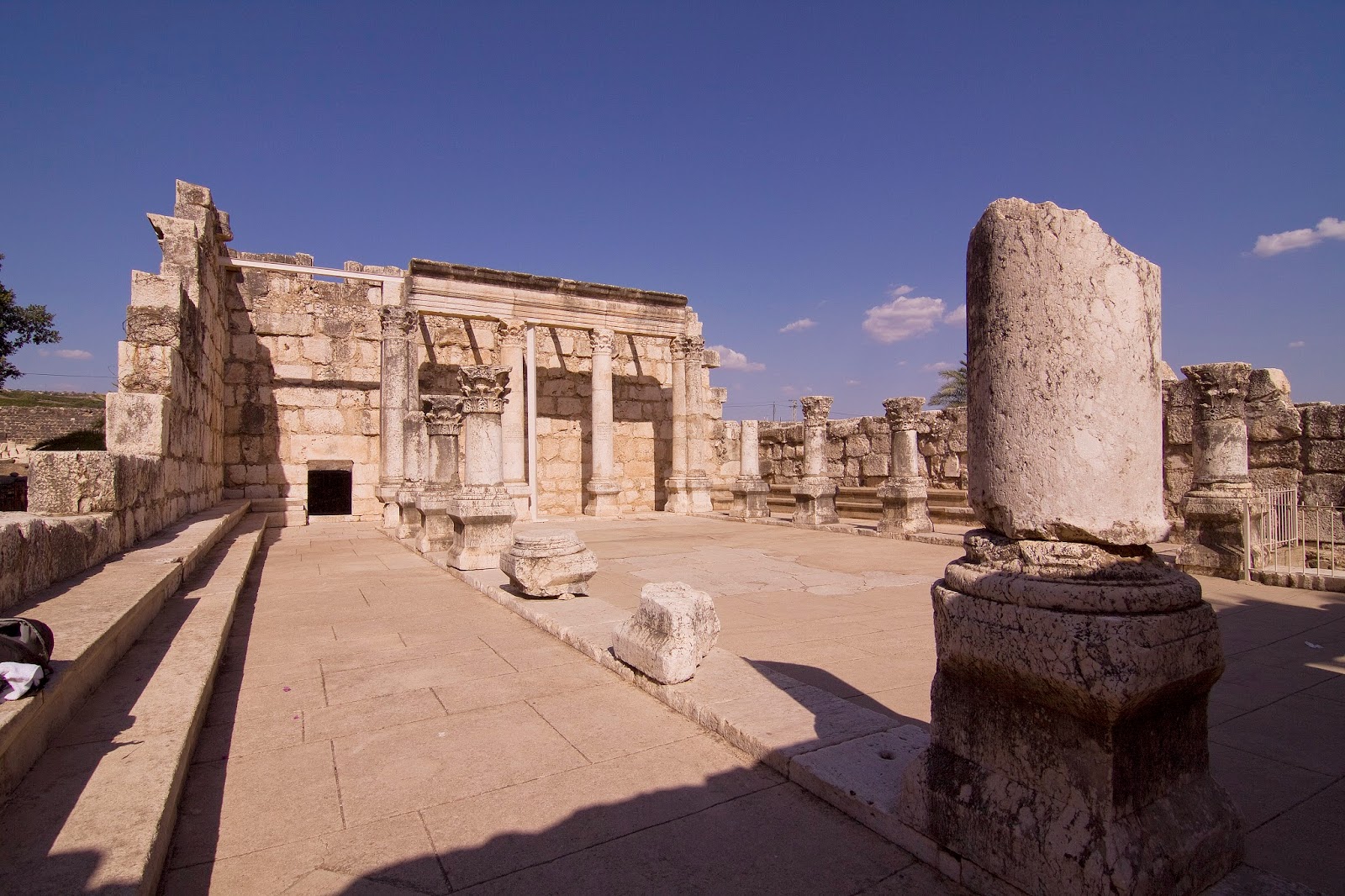
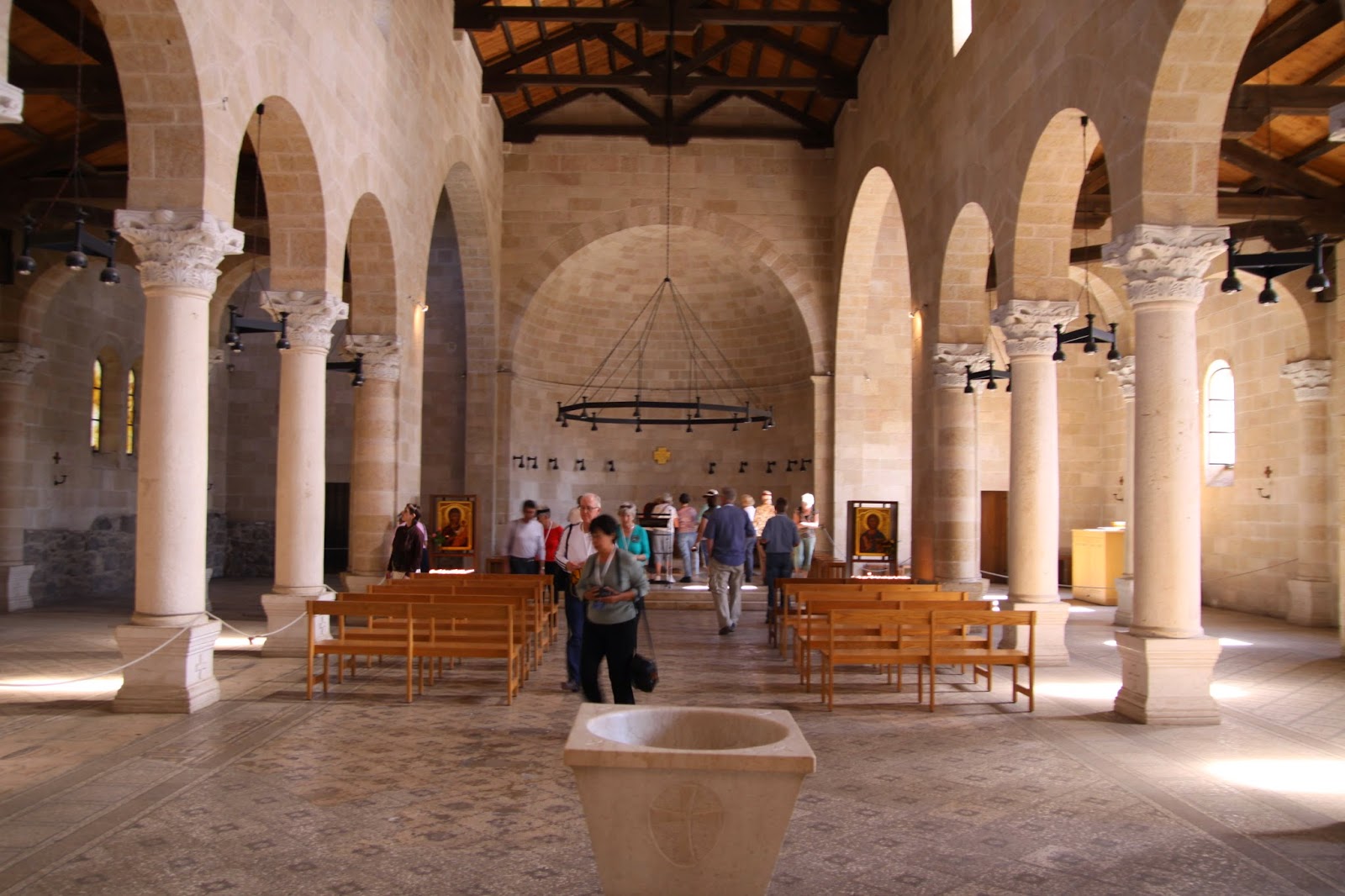
Here we will see a 4th century Synagogue, built on the foundation of the first century synagogue that Jesus preached in. We'll also see ruins of a house that may have been the home of Peter and the place Jesus lived when in Capernaum. Near Capernaum, we'll visit two sites that remember events in Jesus life: The Mount of Beatitudes church, where we remember the Sermon on the Mount. Then, we walk down the hill to Tabgha to visit the Church of the Loaves and Fishes and the Church of St. Peter’s Primacy by the shore. We'll round out this busy day with visit to Chorazin (a town cursed by Jesus for not responding to the miracles he did there). We'll visit Kursi, the most likely place where Jesus healed a man plagued by a legion of demons. Finally, we ascend the eastern ridge to the Golan Overlook for an amazing view of the lake.
Back to Kibbutz Ma’agan for the night.

Day 8 - North Jordan River

Friday, October 31
Today we visit the far north, driving along the Rosh Pinna Road. First we stop at "Et-Tell", possibly the location of Biblical Bethsaida.

We head north to ancient Hazor, the most important town in northern Canaan when the Israelites conquered the area in the 13th century BC. We continue to Caesarea Philippi (now called Banias), a source of the Jordan at the foot of Mt. Hermon—where Peter confessed his belief that Jesus is the Christ. Close by is Tel Dan. We will visit the high place where Jeroboam son of Nebat set up a golden calf when Solomon's kingdom was split in two. We will return to the lake via the Golan Heights, with a view toward Damascus and possibly a stop at a Druze village. Dinner and our final overnight at Kibbutz Ma’agan.

Day 9 - South Along the Jordan

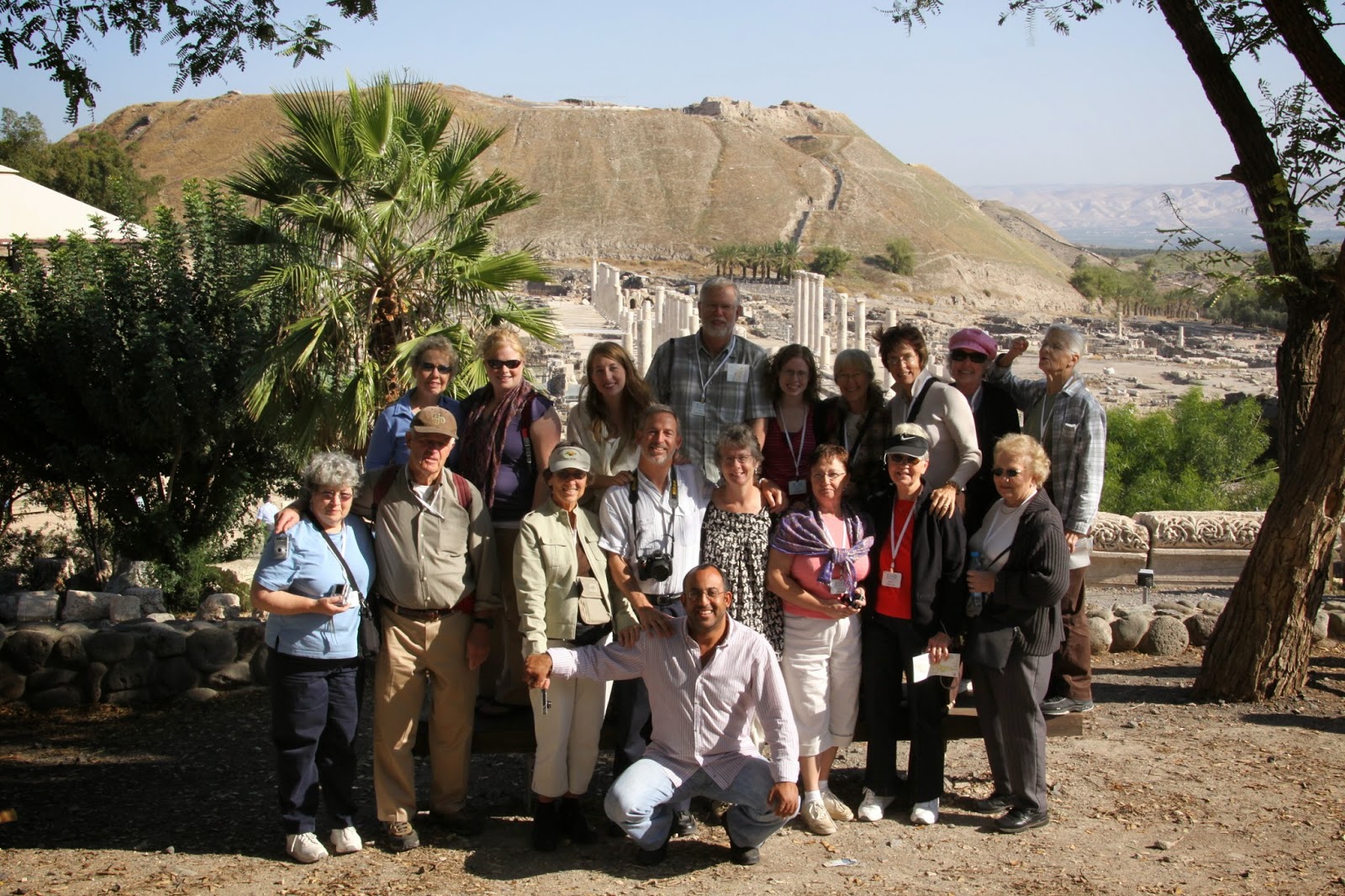
Saturday, November 1 Today we leave the Sea of Galilee and head south through the Jordan valley. Our first stop will be one of the most amazing archaeological sites anywhere: Bet She'an.

Bet She'an (aka Scythopolis), was a non-Jewish city in Jesus' time. We will climb the "tel" and view the setting where Israel's first king Saul and his sons were hung on the city wall when they were killed in battle. We'll walk the magnificent Roman and Byzantine ruins: theatre, bathhouses, ancient rest rooms, market areas, colonnaded streets. Next, we drive south through the Jordan River valley to Jericho, the first city in the Promised Land conquered by Joshua and the Israelites and one of the oldest cities in the world. We'll ascent the tel and imagine what it was like to be encircled by the Israelites.
Or, watching Jesus from a Sycamore tree.
We next travel a short distance to Qumran, located at the northern tip of the Dead Sea, to see the remains of the Essene community. It was here that the Dead Sea Scrolls were discovered in nearby caves.
Tonight we stay on the shores of the Dead Sea. We'll have time for you to take a "float" in the waters that are 30% salt.

Our hotel on the Dead Sea.